


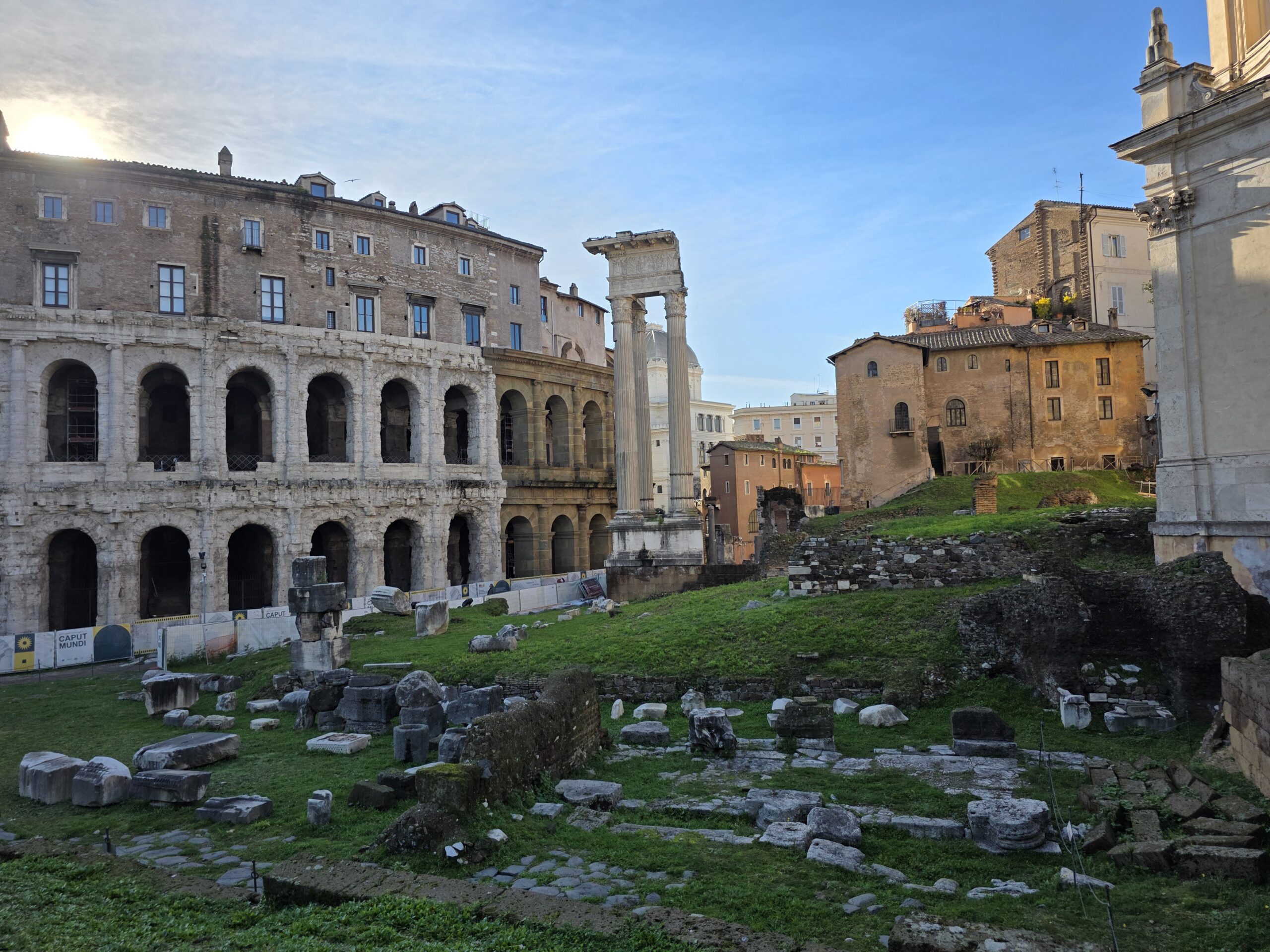
11 Jan Inside the Teatro di Marcello and Palazzo Orsini
The Roman Theatre That Became a Fortress, Then a Palace in 4 Acts
There’s a corner of Rome where the centuries don’t line up politely. They stack, collide, and lean into each other like a city that never learned the meaning of “start over.” The Teatro di Marcello is the clearest example of that refusal — a building that began as Augustus’ architectural flex and ended up as someone’s Renaissance apartment block.
You don’t need a tour guide to feel the layers. You just stand there and the whole structure hums with accumulated time.
Act I — Augustus Builds a Prototype (1st Century BCE)
The Teatro di Marcello was Augustus showing the world what Rome could do. A freestanding theatre — not carved into a hillside like the Greeks — with stacked arches, superimposed orders, and a curved façade that would later become the blueprint for the Colosseum. Not “similar.” The prototype.
And just beside it, three Corinthian columns rise from the ground like a memory. They belong to the Temple of Apollo Sosianus — older than the theatre, rebuilt by a man who backed Mark Antony. Politically awkward, architecturally exquisite. Augustus kept them anyway. Rome absorbs; it doesn’t erase.
Act II — The Theatre Becomes a Fortress (Middle Ages)
When the Empire fell, the theatre didn’t. Rome did what Rome always does: it repurposed. The elegant Augustan structure was swallowed by medieval walls, fortified, subdivided, and fought over by noble families. The arches were bricked in. The seating became battlements. The theatre became a stronghold.
It’s not pretty, but it’s honest. Rome survives by adaptation, not nostalgia.
Act III — The Orsini Move In (16th Century)
Then the Renaissance arrived, and with it the Orsini — a family who collected power the way others collect porcelain. They looked at this ancient theatre‑turned‑fortress and thought, Perfect. Let’s live on top of it.
So they built a palazzo directly onto the Roman structure. Not beside it. Not inspired by it. On it.
The theatre’s arches became their foundations. The curve of the cavea dictated the shape of their home. The whole thing became a hybrid: Roman engineering below, Renaissance domesticity above.
It shouldn’t work. But it does — spectacularly.
Act IV — A Living Building (Today)
People still live there. Private apartments. In a structure that is simultaneously an Augustan theatre, a medieval fortress, a Renaissance palazzo, and a modern residence.
It’s the entire Roman philosophy in one building: this city doesn’t replace its past — it builds on top of it.
The Teatro di Marcello and Palazzo Orsini don’t tell a single story. They tell all of them at once — layered, contradictory, and completely alive.
Rachel Medina
Posted at 08:44h, 24 JanuaryLorem ipsum dolor sit amet, consectetuer adipiscing elit. Aenean commodo ligula eget dolor. Aenean massa. Cum sociis Theme natoque penatibus et magnis dis parturient montes quis.