


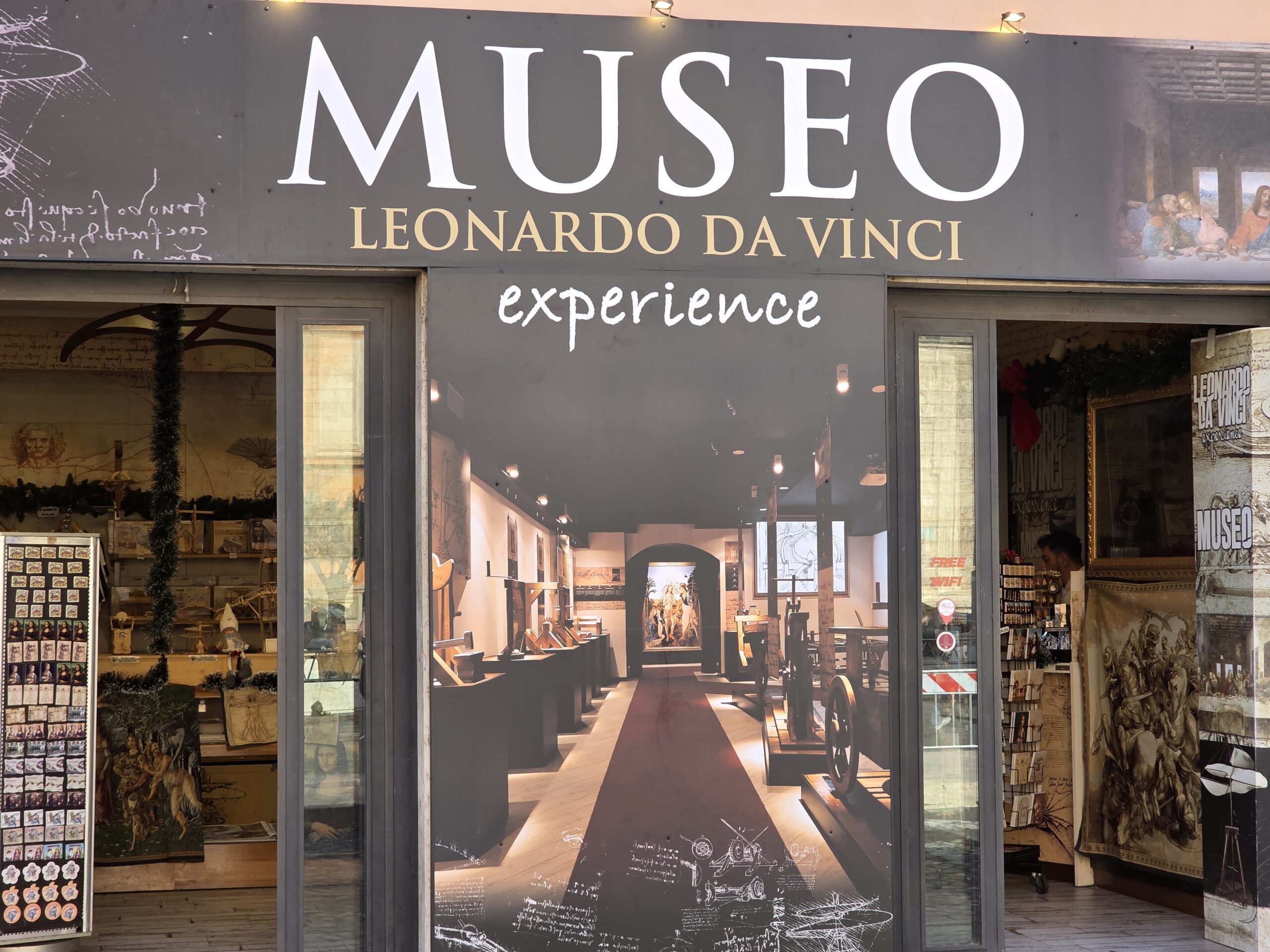
08 Jan Leonardo da Vinci Experience — A Small Museum That Lets You Stand Inside a Mind That Never Stopped Moving
Leonardo da Vinci is one of those names we say as if it were a category rather than a person, but when you sit with his life — 1452 to 1519 — you realise he wasn’t a genius in the modern, glossy sense. He was a man who simply refused to stop paying attention.
Everything interested him. The way a bird lifts itself into the air. The way water folds around a rock. The way a tendon pulls a finger into motion. The way light softens a cheek. His notebooks spill over with sketches and questions, and his paintings carry that same quiet intensity — the sense that he was trying to understand the world from the inside out.
That’s the Leonardo you bring with you when you step into the Leonardo da Vinci Experience near the Vatican. The museum doesn’t announce itself with grandeur. You walk in off Via della Conciliazione into a small merchandise area, buy your ticket, and for a moment you wonder if you’ve wandered into something forgettable. But then you step through the doorway, and the noise of the street drops away.
The first level opens into a gentle introduction — a taster of his world. It’s not trying to impress you; it’s simply shifting your attention. A few pieces, a few ideas, just enough to ease you out of the Vatican crowds and into Leonardo’s headspace.
Downstairs is where the museum actually reveals itself. The space is divided into two distinct areas. One side holds the working models — three‑dimensional interpretations of his mechanical drawings. Some visitors treat them as interactive; the museum allows it. I didn’t.
I was too busy absorbing the fact that these shapes and structures began as lines in a notebook five centuries ago. You don’t need to touch them to feel the point. You stand there, tracing the logic with your eyes, and you start to see how many of these principles — gears, pulleys, the transfer of motion, the earliest thinking behind flight and hydraulics — are the quiet ancestors of the world we live in now. Leonardo wasn’t predicting the future. He was simply paying attention to the present with more intensity than anyone else.
The other side of the lower level shifts the mood entirely. Here you find reproductions of his paintings — beautifully done, and offering something the originals rarely allow: stillness. You can stand in front of the Mona Lisa or the Last Supper without crowds pressing in, without glass, without the sense that you’re stealing seconds from the next person in line.
You can actually look. At the softness of a shadow. The way a face turns. The quiet intelligence in a pair of eyes. These works belong to the long arc of his artistic life, from the 1480s to the 1510s, and seeing them gathered together — even as reproductions — lets you feel the continuity in his thinking. The same curiosity that drove his mechanical studies is right there in the way he painted a smile.
The museum is small, and that’s precisely why it works. It doesn’t try to be everything. It doesn’t need to. What it offers is a distilled encounter with Leonardo’s mind — the inventions, the paintings, the restless curiosity that shaped so much of what came after him.
A rubbish truck lumbers past, and suddenly you’re seeing the same gear‑and‑pulley logic you were just looking at downstairs. A construction hoist lifts a load of bricks, and you can almost map it back to one of his lifting devices. Even the articulated arm of a bus door — that simple, everyday hinge — feels like a direct descendant of the mechanical joints he sketched over and over again. Rome hasn’t changed, but it’s as if someone has quietly overlaid Leonardo’s drawings onto the street.
It’s not that the museum changes Rome. It just sharpens your attention — the way Leonardo sharpened his. And for a moment, walking back into the sun, you feel the city humming with the same quiet logic he spent his life trying to understand.
No Comments