


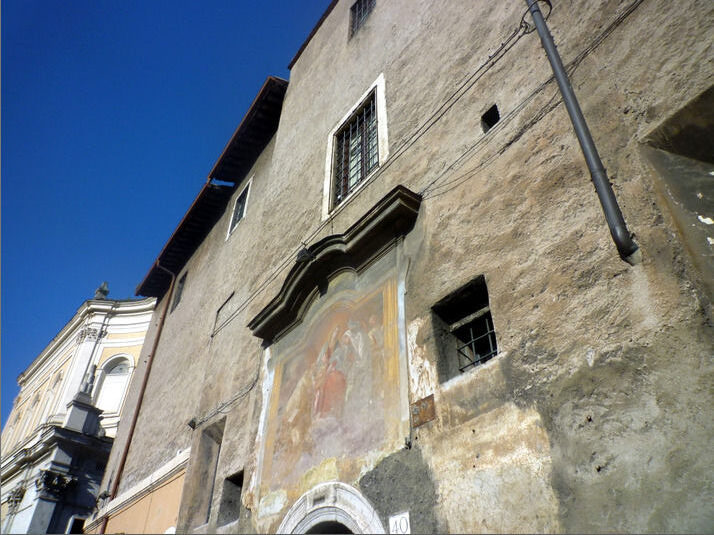
23 Feb Tor de’ Specchi: The Convent That Opens Its Doors for One Day a Year
There is a door on the Capitoline Hill that stays closed all year. No sign, no explanation — just a long-weathered façade that most people pass without realising what lies behind it. But on 9 March, for a few hours only, that door opens. And Rome steps into one of its most intimate and least accessible spaces: Tor de’ Specchi, the monastery founded in 1433 by Santa Francesca Romana.
This annual opening is not a tourist event. It is a tradition that has continued for nearly six centuries, tied to the feast day of a woman whose life shaped Rome in ways that still feel startlingly modern.
Who Was Santa Francesca Romana?
Francesca (1384–1440) was a Roman noblewoman who lived through plague, famine, political violence, and personal tragedy. Instead of withdrawing, she moved toward the suffering around her. She fed the hungry, cared for plague victims, opened her home to the sick, and walked the streets at night with a lantern to guide those who had no one else.
Her compassion was practical, grounded, and deeply Roman. She understood the city from the inside.
In 1433, she founded the community of the Oblates, a group of women who lived a life of prayer while remaining engaged with the world — a radical idea at the time. Tor de’ Specchi became their home.
What You’ll See Inside
The monastery is normally closed, which is why so few images of the interior exist. But on 9 March, visitors can enter the small, frescoed rooms that tell Francesca’s story.
Painted shortly after her death by the circle of Antoniazzo Romano, the frescoes depict:
Francesca distributing bread during famine
Francesca caring for plague victims
Francesca tending to the sick in her home
Francesca guided by her guardian angel
Scenes of daily life in 15th‑century Rome
These are not grand, theatrical images. They are intimate, domestic, and deeply human — a visual biography created by people who knew her or lived close to her memory.
The rooms themselves are modest, almost unchanged since the 1400s. You feel the continuity of a community that has lived here quietly for centuries.
Why It Matters
Tor de’ Specchi is one of Rome’s most meaningful annual openings because:
It preserves a 600‑year‑old tradition
It reveals a rare fresco cycle that is almost never accessible
It honors a woman whose influence on Rome was built on service, not spectacle
It offers a glimpse into a living monastic community that has shaped the city quietly and consistently
This is not a “hidden gem.” It is a place that has never needed to be seen to be important.
When & Where
Date: 9 March (every year)
Hours: Typically morning to early afternoon (times vary slightly each year)
Location: Monastero delle Oblate di Santa Francesca Romana
Via del Teatro di Marcello, at the base of the Capitoline Hill
Admission: Free
Booking: No reservation required — but arrive early. The line forms quickly.
Why You Should Go
Because this is Rome at its most authentic: a city that reveals itself slowly, through tradition rather than performance. Tor de’ Specchi opens just long enough each year to let you step into a space where history hasn’t been curated — it has simply continued.
If you’re in Rome on 9 March, this a door worth standing in front of.
Photo Attribution: Ragusaibla, CC BY-SA 4.0, via Wikimedia Commons

No Comments