


08 Jan Campo de’ Fiori: Rome’s Most Contradictory Square
Campo de’ Fiori is one of those Roman spaces that refuses to behave like a piazza. A typical Roman square has a clear architectural logic: a church anchoring one side, a symmetrical layout, a central monument or fountain, and buildings arranged to frame the space like an outdoor room. Campo de’ Fiori has none of that. No church, no symmetry, no formal centre. Instead, it’s a living stage — chaotic, theatrical, and stubbornly alive in a way that feels almost pre‑modern. Beneath the market stalls and aperitivo tables is a history far darker and stranger than most visitors searching for “Campo de’ Fiori Rome” or “Campo de’ Fiori history” ever realise.
In the Middle Ages, this area wasn’t a piazza at all. It was a low, marshy field just outside the more formal city. The name — “field of flowers” — likely refers to the wild vegetation that grew here before the land was drained and paved in the 15th century under Pope Callixtus III. Once paved, the transformation was immediate: inns, workshops, and taverns appeared, and the square became a place of commerce, gossip, and trouble. It has never quite lost that edge, which is why people still ask why Campo de’ Fiori is famous and what makes it so different from other Roman squares.
The daily Campo de’ Fiori market began in the 1800s and still carries the energy of a working‑class Rome that’s disappearing elsewhere. It’s messy, loud, uncurated — the opposite of the polished markets tourists expect. And that’s precisely its charm. Visitors often search for “Campo de’ Fiori market hours,” but the real story isn’t the schedule — it’s the atmosphere, the unfiltered Roman life that spills into the square every morning.
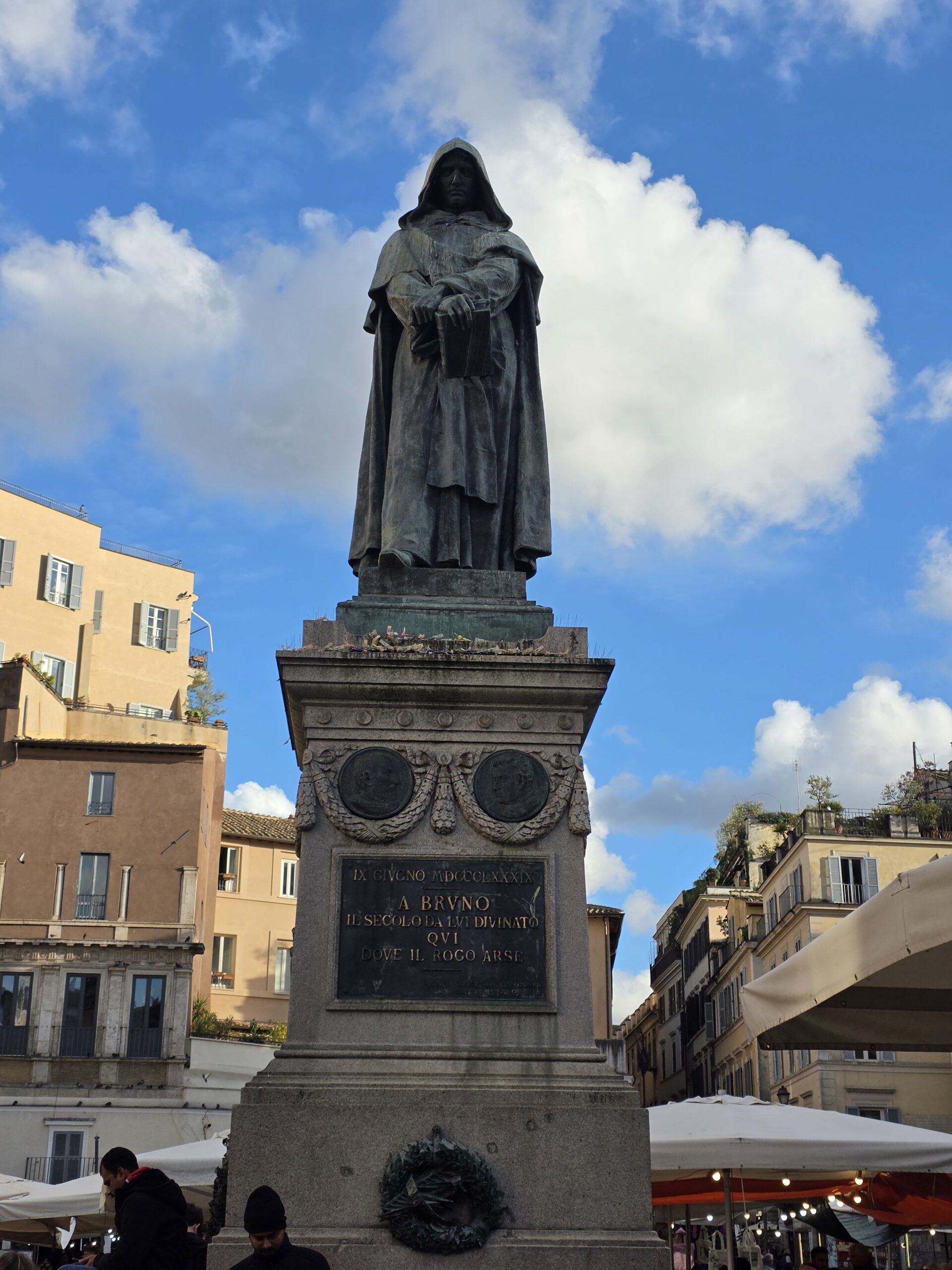
At the centre stands the brooding statue of Giordano Bruno, the philosopher burned at the stake here in 1600 for ideas the Church found intolerable. His statue doesn’t face the Vatican by accident. It’s a permanent act of defiance — the only monument in Rome that accuses rather than celebrates. People often ask, “What happened to Giordano Bruno in Campo de’ Fiori?” The answer is written into the posture of the statue itself: Rome remembers its heretics as sharply as its saints.
By day, Campo is produce, flowers, and vendors shouting prices. By night, it becomes a different creature entirely: bars, students, and a kind of Roman nightlife that feels both ancient and contemporary. Visitors often wonder whether Campo de’ Fiori is safe at night — and the truth is that it’s lively, unpredictable, and unmistakably itself. Campo de’ Fiori is Rome at its most unfiltered — a place where history isn’t curated; it’s lived.
Rachel Medina
Posted at 08:44h, 24 JanuaryLorem ipsum dolor sit amet, consectetuer adipiscing elit. Aenean commodo ligula eget dolor. Aenean massa. Cum sociis Theme natoque penatibus et magnis dis parturient montes quis.