


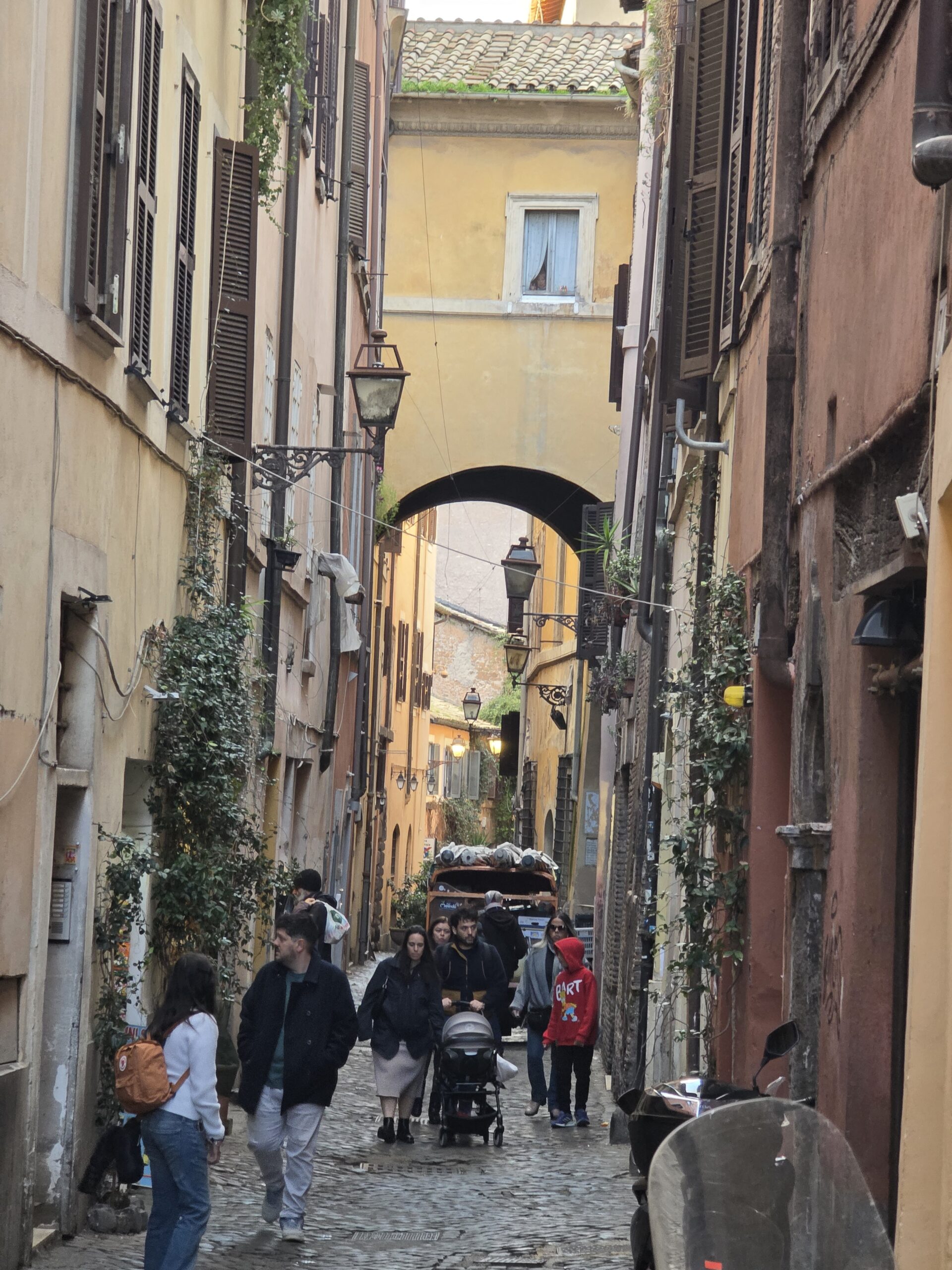
06 Jan Via dei Cappellari: The Street That Remembers Its Craftsmen
Via dei Cappellari is one of those Roman streets that reveals itself slowly. Narrow, slightly curved, lined with small doorways and artisan‑sized workshops, it still carries the memory of the craftsmen who once worked here. People searching for “Via dei Cappellari Rome” or “medieval streets near Campo de’ Fiori” often stumble onto it by accident — and immediately feel they’ve slipped into a quieter, older layer of the city.
The name comes from the cappellari, the hat‑makers, who filled this street during the Middle Ages and Renaissance. Their workshops produced the felt hats worn by clergy, merchants, and everyday Romans. The street’s shape tells the story: narrow enough to stay cool, wide enough for workbenches, perfectly scaled for artisans. Visitors often ask, “Why is it called Via dei Cappellari?” The answer is written directly into the architecture — this was a working street, a place of hands and tools and trade.
Unlike the grand piazzas nearby, Via dei Cappellari never underwent major redesign. It escaped the 19th‑century demolitions and the Fascist‑era “liberations” of monuments. It remains a medieval street in a Renaissance neighbourhood, which is why it appears in so many searches for “hidden streets in Rome” and “artisan history near Campo de’ Fiori.” Walking it is like slipping into Rome’s backstage — the part of the city that supported the spectacle without ever needing to be the spectacle itself.
The street links Campo de’ Fiori to Piazza Farnese — two spaces with completely different energies. One is chaotic and unfiltered; the other is composed and architectural. Via dei Cappellari is the quiet corridor between them, the place where daily life happened: craftsmen working, neighbours talking, goods moving from workshop to market. It’s the human‑scale Rome that holds the city together, the connective tissue that explains how these neighbourhoods functioned long before tourism shaped their rhythms.
Today, people often search for “how to walk from Campo de’ Fiori to Piazza Farnese,” and the answer is simple: take Via dei Cappellari. But the real pleasure isn’t the shortcut — it’s the sense of continuity. This street still feels like what it once was: a working artery, a lived‑in passage, a reminder that Rome’s beauty isn’t only in its monuments but in the spaces that quietly support them.
Rachel Medina
Posted at 08:45h, 24 JanuaryLorem ipsum dolor sit amet, consectetuer adipiscing elit. Aenean commodo ligula eget dolor. Aenean massa. Cum sociis Theme natoque penatibus et magnis dis parturient montes quis.